How I Returned to Painting

In 2025, my son was born, and with him a new chapter of my life began. That was when I decided to return to painting.
For years, I had continued working in creative fields such as graphic design, post-production and digital environments. I never stopped creating images, but I had moved away from physical materials. From oil paint, brushes and that particular sense of time that exists only in front of a painting.
I did not return with a fixed plan. I needed to begin somewhere simple, without thinking too much or demanding that I immediately find a clear direction. Landscape offered me that space.
It allowed me to follow colour, light and brushwork. To reconnect with the material and let the image emerge gradually. To paint without needing to know in advance where I was going.

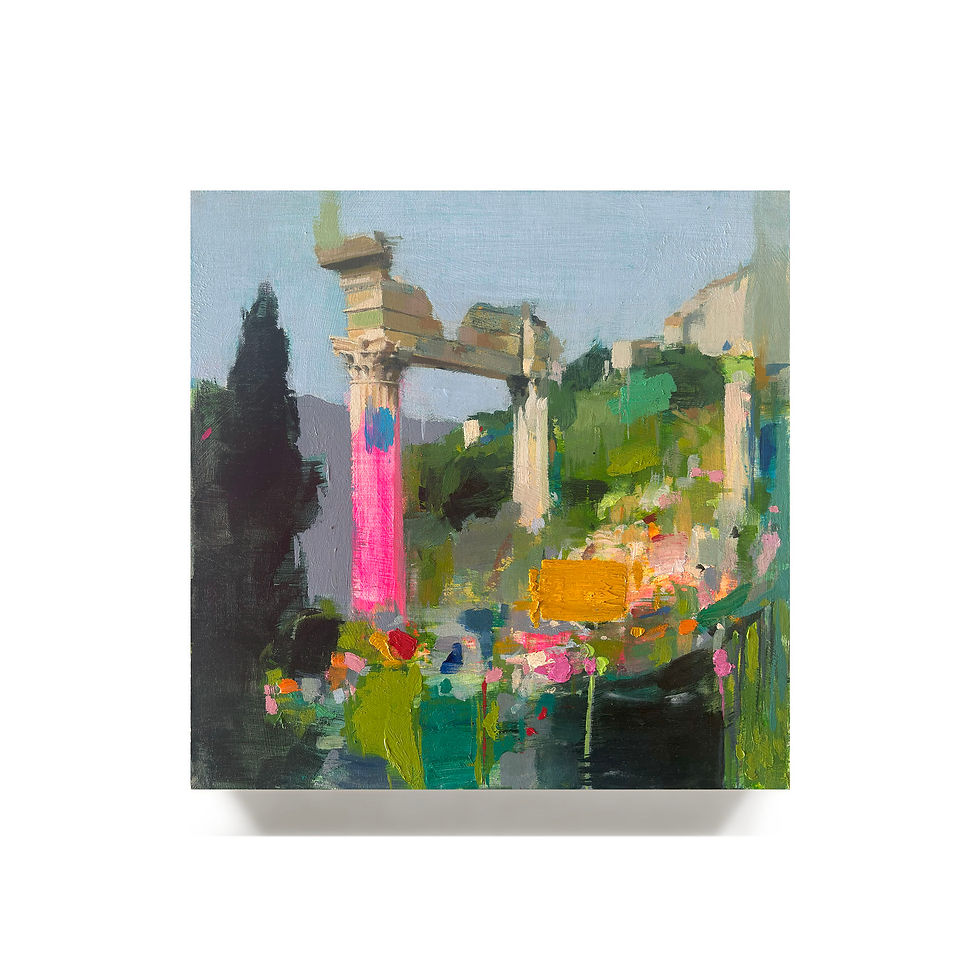
Tis is how the first Landscapes of the Unconscious came into being.
They were not real places. They were imagined landscapes built from ruins, temples, horizons and memories that seemed to come from somewhere difficult to name. Spaces where lived experience and imagination could coexist.
Landscape became a way of reconnecting with the unconscious territory that painting had always occupied within me. A way of loosening control, entering other worlds and listening to whatever emerged while I worked.
Over time, something began to change.

All my previous experience in design and digital environments started to enter the paintings. It appeared in the compositions, the intense colours, the luminosity of certain images and the fragments that sometimes resemble a screen, an interference or a system that has stopped working as expected.
What I had considered a separate stage of my life began to find its place within my pictorial language.

This discovery allowed me to move towards the painting I truly wanted to develop.
My work gradually became more focused on the human figure and the relationship between identity and environment. It became a form of painting situated between figuration and gestural abstraction, where the body can merge with its surroundings and the image seems to be forming and dissolving at the same time.
My interest in error also emerged. Not as something that must be corrected, but as a possibility. A crack capable of changing the expected direction and taking the painting somewhere I did not yet know.
Landscape was no longer the centre of my work, but it never disappeared completely. In a sense, it entered the figure. The body began to behave like a territory, while the background ceased to be a simple setting and became part of the construction of identity.


Today, I see these landscapes as a record of my return.
They were the place from which I rediscovered materiality, the freedom of the brushstroke and the pleasure of painting without having all the answers. Some of these works have found new homes. Others remain with me, and those are the paintings I have brought together here.
They do not represent exactly where my painting is heading now, but they do represent the place from which I was able to begin again.